A phase-gated, Part 103 electric flying wing
Designed for garage manufacture. Instrumented for technology maturation. This deck tells one story in four acts — credibility, maturity, process, and the ask.
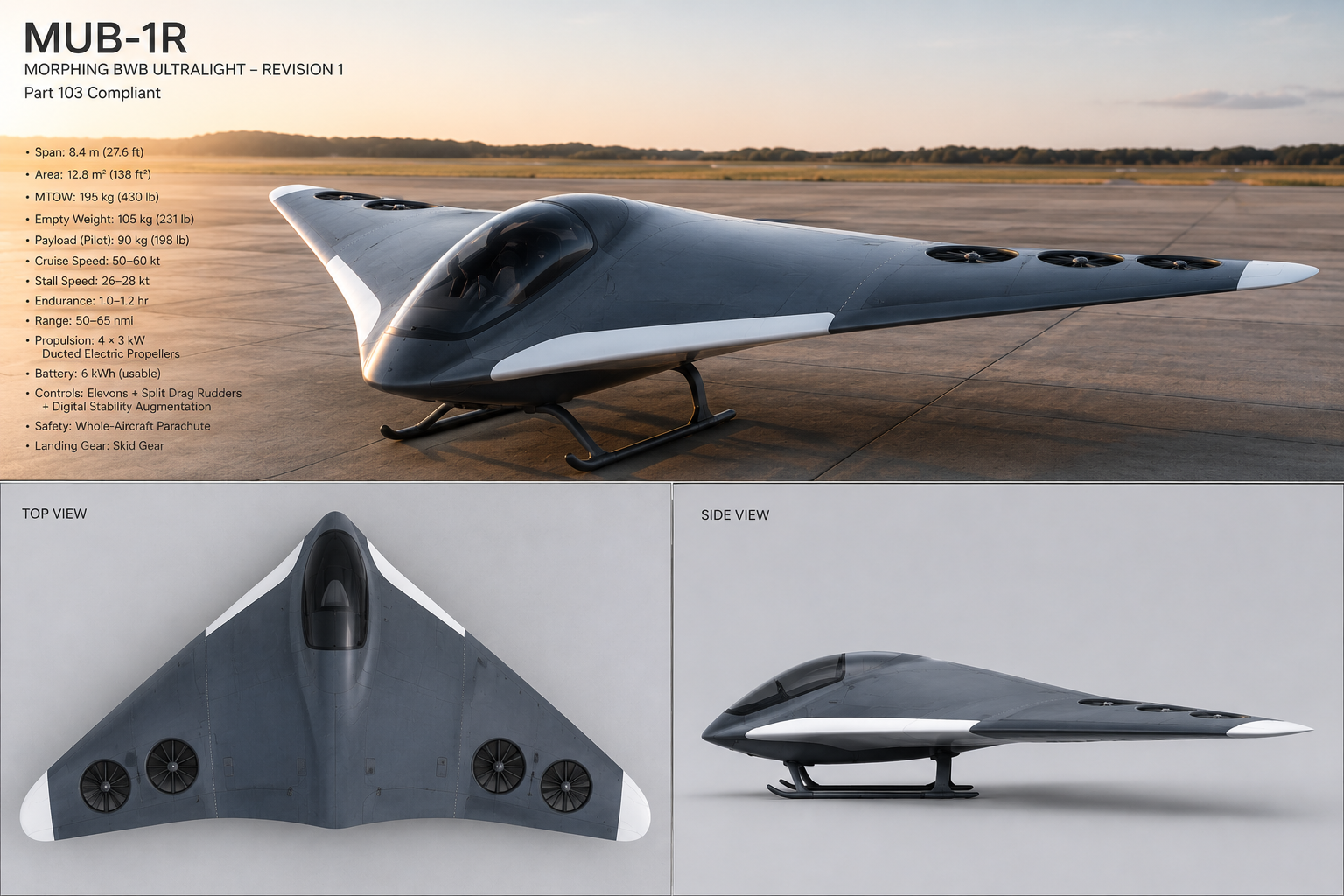
The Aircraft in 30 Seconds
One spec table. No prose. The numbers speak.
Span
10.4 m
Wing Area
19.5 m²
MTOW
210 kg
Empty Weight
115 kg
Stall Speed
24 kt
Cruise Speed
50–60 kt
Propulsion
2× 10–12 kW
Battery
4.6 kWh
Endurance
~1.0–1.2 hr
Range
50–65 nmi
Controls
Elevons + SDR + DSA
Safety
Whole-Aircraft Chute
Why This Configuration
Part 103 — Legal Innovation Sandbox
No pilot certificate required, no aircraft registration, no airworthiness certification. This regulatory lane enables rapid iteration without bureaucratic overhead.
Tailless Flying Wing
Low wing loading for gentle stall, large solar-capable center body, aerodynamically efficient. The configuration that makes the mission possible.
Flat-Panel Composite
CNC-compatible, repairable, garage-buildable. Every structural element can be made with a hot-wire cutter, a vacuum bag, and patience.
Every choice traces to: buildable, legal, survivable.
Program Structure: Two Tracks
Track A — The Aircraft
Conservative, manned, legal aircraft flying first. Mechanical controls, proven materials, quantified gates at every phase boundary. This is the product.
Track B — Technology Maturation
Advanced tech — energy storage, BLI, morphing, solar — maturing behind quantified pass/fail gates. Each graduates individually onto the proven airframe, or stays on the bench.
“The exotic technology never flies on an unproven airframe,
and the pilot never flies on unproven technology.”
14 Risks Identified. None Hidden.
The risk register carries 14 identified program risks, scored by severity × likelihood both pre- and post-mitigation. Three safety-critical risks carry residuals of 10 — because they can only be retired by flight test itself. We talk about those, not hide them.
The Risks We Cannot Mitigate Away
These carry residual scores of 10 because they require flight data to retire. The honest response is to build the test program around them.
Pilot Proficiency Mismatch
The historical #1 killer in experimental aviation. Mitigation: dual instruction + glider time before Phase 1D, 5+ crow-hop sessions, written personal minimums, helmet + whole-aircraft parachute mandatory. Stated openly as the program's largest residual risk.
Departure from Controlled Flight (Tailless CG)
1/4-scale CG sweep from 14% → 8% static margin. First flights at 12% margin, mandatory W&B every phase change, nose ballast provisions from day one. The model program exists to buy down this risk before the pilot is aboard.
Reynolds / Scale Gap
The 1/4-scale model flies at Re ≈ 3×10⁵ vs full-scale 1.6×10⁶ — spanning the laminar separation bubble regime. Trip strips and tuft testing make data partially transferable; model data treated as advisory only. The full-scale envelope expansion protocol is sized around this known blind spot.
The Risks the Architecture Suppresses
These residuals are low because the design pays for them, not because the spreadsheet wants them low.
Battery Thermal Runaway
Dual isolated packs, overboard venting, packs outside cockpit crush zone. P45B-class cells inherently more runaway-resistant than pouch.
Wing Join Failure
6.6g ultimate (50% reserve over limit), proof test + sacrificial join specimen broken on purpose, metallic fittings bolted AND bonded.
Control Surface Flutter
100% static mass balance, freeplay < 1 mm, Vne = 1.4× max demonstrated. Standing rule: no mass on control surfaces, ever.
Phase-Gated Roadmap
No phase begins until the previous gate passes with documented evidence. The gates are contractual — and would be contractual with a partner.
Foundation
$1,400In ProgressExit gate: Model flies predictably; coupon tests pass
Cockpit Cell + Center Section
$2,200Exit gate: Static load proof test pass (4.85g equiv.)
Wings, Controls, Gear
$2,800Exit gate: Rigging + weight audit ≤ 115 kg
Propulsion + Avionics
$3,000Exit gate: Full-power ground run; W&B in CG box
Flight Test Campaign
$500Exit gate: 10 hr envelope logged; measured cruise power known
Airborne Solar
$3,000–4,500Exit gate: Coupon thermal test pass; cruise ≤ 5.5 kW
Soaring Operations
$1,200Exit gate: Cross-country capable
Flight Test Discipline — 18 Cards, 4 Blocks
One objective per card. Abort criteria written before flight. Block D deliberately left skeletal until Block C data exists.
Taxi, drag-rudder authority, high-speed taxi, vibration survey, abort rehearsal, asymmetric power characterization.
First lift-off below 1 m, control doublets, simulated power loss at 2 m. Exit: 5+ sessions, written observer concurrence.
Trim & stability survey at 2,000+ ft, slow flight in 2 kt steps, stall characterization at 3,000+ ft.
Speed to Vne, maneuvering to 2g, single-motor-out, and the cruise-power deliverable that gates Phase 2.
What the Data Feeds
The vision — solar-extended cross-country range — arrives as the output of a process, not a fantasy.
Specific. Bounded. Tiered.
Companies say yes to small concrete things and no to vague big ones. Tier 1 is the actual ask. Tiers 2–3 exist so partners can volunteer upward.
Engineering Review
- Engineering design review of spar & wing-join package
- Periodic technical mentorship
- FEA review of classical beam analysis (invited)
Lowest cost to partner — highest leverage to the program. A flaw found on paper costs nothing; the same flaw found in flight costs everything.
Manufacturing Support
- CNC / shop time for flat-panel kit
- Composite consumables at cost
- Process guidance on vacuum-bagged layups
Directly accelerates Phases 1A–1C and tightens the weight budget — the most likely serious program risk.
Program Partnership
- Instrumentation support for Track B experiments
- Flight test facility access
- First position on Track B technologies
A documented testbed for low-Re electric flight data, plus defined IP position and co-publication options.
What Partners Get
Instrumented Testbed
A documented testbed for low-Reynolds electric flight data — every flight logged from day one.
Genuine PR Value
Association with a disciplined grassroots program — real credibility in the light-aviation world.
Track B First Position
First position on rib-pack energy storage, BLI, and morphing technologies if any pass their gates.
Defined IP Position
Builder retains airframe design rights; partner receives negotiable data access, co-publication, or license options.
Risks to the Partnership Itself
We've pre-planned how to say no — even to partners. That reads as integrity, not arrogance.
Schedule Optimism / Abandonment
Your involvement is itself a mitigation — external accountability measurably improves homebuilt completion rates.
Partner Scope Creep
The gate structure is non-negotiable. If your team falls in love with the morphing wing, it still waits its turn.
The airplane is already underway.
The question is whether it flies with your fingerprints on it.